
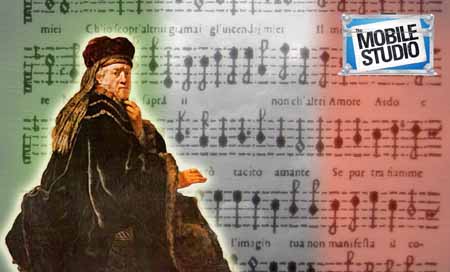
The 16th century Jewish composer Salamone de’Rossi is one of the more elusive figures in the world of Jewish liturgical music. All we know about him is the music which he left to us. In this first podcast in what I hope will be a series on the Jewish composers, Stephen Newman tries to find out a little more about Salamone de’Rossi the man, how his music was influenced by the world in which he lived and why we know so little about him. The podcast includes examples of de’Rossi’s work performed by the Zamir Chorale of Boston.
Books
Salamone Rossi: Jewish Musician in Late Renaissance Mantua – Don Harran

Jewish Music: Its Historical Development – Abraham Idelsohn

Shir HaShirim – Salamone de’Rossi
CDs and Music
Salamone Rossi Hebreo, Baroque Music for the Synagogue and Royal Court – The Zamir Chorale of Boston

Salamone de’Rossi’s Al Naharot Bavel – Profeti della Quinta
Links
Download PDF Version of this Transcipt
Salamone de’Rossi
Mobile Studio Podcast #5
Mark:
Welcome to the Mobile Studio podcast #5. Back in podcast #3, together with Stephen Newman, my dad, we tried to answer the question “Is this Jewish music?” and found the Jewish music was quite a difficult thing to pin down. During the podcast, we talked about a number of Jewish composers and since that podcast I’ve been asked to find out a little bit more about them. This is the first of what I hope will be a series of podcasts about these different composers and we’re going to start with a composer who we actually spoke a little about in one of the podcast extras, the Italian composer Salamone de’Rossi.
Music: Kaddish
Mark:
So we’re sitting here over a rather nice glass of Italian red wine to talk about Salamone de’Rossi. What do we know about the man himself?
Stephen:
We know he worked in the Mantuan court from 1587 to 1630, well in fact 1628. How do we know this? Well, my source for most of this discussion is a fascinating book called “Salamone Rossi: Jewish Musician in the Late Renaissance Mantua” by Don Harran, published by Oxford Monograph on Music. Also I will refer to Abraham Idelsohn, Jewish music and historical development. Don Harran went and did a lot of original research on Salamone de’Rossi. He was dissatisfied with what he saw written about Salamone de’Rossi. Why was this? Well we don’t know a lot about Salamone de’Rossi. What we do know is he’s the first Jewish composer where we’ve got a complete set of works for the synagogue, written specifically for the synagogue, written in 4 part harmony and written in western standard notation, musical notation.
Why is that important? Well up to the Renaissance period, musical notation has been developing, but developing in a way that didn’t allow you to actually understand what the tempo was, what the melody was or what the key was simply because it used these scrawls, which in Hebrew called “Te’amim”, meaning taste; the scrawls added taste to the words; in Europe they were referred to as “Neumes” where the church fathers developed a standard notation. The standard notation was squiggles up and squiggles down and squiggles across. If you knew that, that was fine, but you would only know what the mode, you wouldn’t know the particular mode. You’d know what modes it referred to and one squiggle could have different meanings in different modes. In the church modes for example, in the Phrygian mode, the squiggle would have a different meaning than Dorian mode. In the Jewish modes the Te’amim would have a different meaning in the Ahava mode and the Magen Avot mode. So you really were quite stuck as to know what the original melody was.
What Salamone de’Rossi gave us was he gave us the melodies and the harmonies written out so we could actually sing them today. So if I pick up Salamone de’Rossi’s book today I can sing the parts.
Mark:
So Salamone de’Rossi was the first Jewish composer to write out this music in modern western notation.
Stephen:
Yes, yes he was. That’s important to Jewish music. We do have some specimens of Jewish music earlier than that. One dating from about the 11th or 12th century by a convert to Judaism called Ovadia the Norman or Ovadia the proselytite thought to be a monk who converted to Judaism and wrote a setting of “Baruch HaGever – Blessed be the Man”.
Music: Baruch HaGever
Stephen:
That emerged into the hands of western archaeologists in the end of the 19th century by 2 redoubtable women, 2 sisters who found these scraps of parchment in the Geniza in the Cairo synagogue. Geniza being a store house of Jewish documents usually in the attic in this case, the attic of the old synagogue in Cairo. The reason for that is in Judaism if you have a piece of paper or a piece of parchment with the name of God on it, you are never allowed to destroy it. The only way you can dispose of it is either to put it in a Geniza or bury it. Fortunately these pieces were put into a Geniza, discovered in the late 19th century, taken to Dr. Schechter in Cambridge University, who then decoded these neumes, as they appeared to be, to give us some idea of what the melody of that Baruch HaGever could be.
So Ovadia the Norman is the oldest one we know about, but it’s Salamone de’Rossi who actually gave us music that we can sing.
Mark:
Why is Salamone de’Rossi such a mystery?
Stephen:
The problem that we have is that Jews at this time lived in the ghetto and were seen very much in the whole of western Europe as being second class citizens proscribed for most professions and trades. They were very, very restricted in what they could actually do. One of the things that the more enlightened dukes of Mantua allowed Jews to do was to write music and de’Rossi was one of several Jewish musicians who were allowed into the Mantuan court. De’Rossi himself was a violinist, apparently a very good violinist, but how do we actually know about him? Well we know about him because Don Harran actually went back to the payrolls of the Duke of Mantua and he looked at 7 payrolls from the period of 1577 to 1637 and there he discovered the names of composers, singers and instrumentalists with Jewish names. More than that, at the end of the name, it was suffixed by Hebreo, which at that time was the Italian for Jew.
So we know that de’Rossi worked from about 1587 because he was on the payroll. Now he disappears in 1628. In 1628, Ferdinand, one of the Dukes of Mantua came to power and he wasn’t particularly pro-Jewish. The previous ones, Vincenzo and his predecessor both were quite pro-Jewish. They were very good to the Jews of Mantua, but Ferdinand wasn’t and gradually the Jewish ghetto in Mantua was, more and more restrictions were placed upon it, so that in 1630 the ghetto was actually ransacked after not a very nice incident where Jews, 7 Jews had been hanged. It could have been that de’Rossi was amongst them, we don’t know, for making fun of the Catholic church. It’s unlikely that de’Rossi was one of them, but he would have had to have fled from the ghetto and not long after that the Austrian Hungarian empire invaded Mantua and they massacred most of the Jewish population anyway so that’s why de’Rossi, we don’t know when he died. We don’t either know when he was born. We know that he appears in the payroll records in 1587, but we don’t really know how old he was because it didn’t say what his age was. So deductions have been made as to when he was probably born and he was probably born around about 1560-1565, something like that. So he was probably in his late, the very, very earliest, his late teens or early 20s when he gets onto the payroll. In looking at his music, he was employed initially as a violinist, but then he developed or impressed the Dukes of Mantua with his compositions and they asked him therefore to compose songs, mainly acapella, but also some instrumentals and we have a number of books of his madrigals, of his instrumental settings and there are CDs around where you can actually listen to this music.
Music: Dir Mi Che Piu Non Ardo – Madrigal for 5 voices
Mark:
…and in the background you can actually hear one of these CDs at the moment. This is from a CD called ” Salamone Rossi Hebreo, Baroque Music for the Synagogue and Royal Court” by the Zamir Chorale of Boston who I’d like to thank for allowing me to use this CD for all the Salamone de’Rossi inserts in this podcast. If you are interested in getting hold of this CD, then you can find a link to it on the homepage for this podcast and that’s at https://www.themobilestudio.net/podcast and go to podcast #5.
What about Salamone de’Rossi’s Jewish music?
Stephen:
His Jewish music is only in one volume and the volume is called “Shir HaShirim Asher Lishlomo – Songs of Solomon”, which many of you will recognize as being the name of the book in the Bible the Jews read on Pesach, the Passover. The reason Salamone de’Rossi called it that was a pun on this book and it’s probable that he knew how good he was, de’Rossi, to actually call it that. He thought he was amongst the greats, which in fact many musicologists agree he was. Definitely he was of the standard of Monteverdi who was his contemporary and there is a lot of evidence to suggest they actually met and even collaborated with Monteverdi.
Music: Keter Yitenu Lakh
When we look at his music, you will notice something very interesting. It does not sound like Jewish music and it doesn’t sound like Jewish music because de’Rossi, although he may have known the Jewish modes, he didn’t compose in them and the reason that he probably didn’t compose in them was at that time, the development of music and harmony did not lend itself to harmonizing Jewish music. First of all, de’Rossi was descended, it’s thought, from a family that came over with the sacking of the Temple in 70AD, brought over by the Romans. Somehow they developed a skill in dying, it’s thought, hence its name, de’Rossi the Red, Salamone the Red.
Mark:
Dying as in with ink?
Stephen:
Yes, as in the dying clothes, yes, so that maybe his family were famous dyers of red clothes. It is a bit speculative, but that’s definitely what some historians seem to believe.
How he got his musical education we’ve just got no idea, especially the fact that although there was probably a lot of Jewish music in the ghetto, the actual development of western music would have been unknown to most of the Jews in the ghetto of Mantua. Anyway, he did and he wrote a whole raft of settings, but they are set to Italian court music. The melodies and the harmonies are purely Italian. They’re not Jewish in any way.
Music: Gagliarda a 5 detta la Massara
So what you’ve got is Italian court music set to Jewish prayers and it gave de’Rossi some fascinating challenges. In a piece that we’re going to hear shortly, Hallelujah Psalm 145, you will hear the stretching of the Hebrew to fit in with the Italian musical methodology and it’s fascinating to listen to how de’Rossi managed to fit the Hebrew in so you get long, as you would with Latin at that time, or with Italian, you get long, maybe 2 or 3 bars of…
Music Extract: Kaddish
in the Kaddish, “Le’eila le’eila” can go on for 2 bars. Meanwhile the sopranos and altos are weaving harmony between the holding of that bit of melody by the tenors, “Tenore” to hold.
De’Rossi obviously struggled to fit it, but he fitted it brilliantly. The emphasis of the music is fascinating. He brings out the meaning so often of the words, so in Kaddish for example, he emphasizes the beginning of each Pasuk, each sentence, he emphasizes with a new thought, with a new piece of melody and harmony. In his Hallelujah, Psalm 145, he emphasizes Hallelujah all the time. It’s got a special place in the whole piece, in the harmony.
Music: Hallelujah
It also presents singers with some very interesting challenges. Jewish singers at this time of the competence necessary for singing de’Rossi’s music must have been few and far between. You have to know your music, you have to be absolutely spot on in pitch. You have to be absolutely spot on in time and you have to be able to emphasize and bring out the crescendo and decrescendo in such a way as to not, to allow the parts to come in between each other and not to snow down the meaning that de’Rossi is trying to put in to that particular passage.
Why is it so difficult? Because unfortunately in the music that we have inherited from de’Rossi, there was no indication of emphasis on crescendo, decrescendo or staccato. That notification is missing in the music so it’s been interpolated by the people who have written out the Renaissance notation into modern music notation. Incidentally there are no bars either, which means you get some quite curious interpretations when you get different numbers of bars for different parts simply to try to help the singers to bring out the various emphasis and parts.
The challenge for the singer, and I can only talk from the tenor, which is what I sing, is you have to be absolutely spot on as I said with everything, note, pitch emphasis, which means you’ve got to think ahead with this music far more than you do normally and if you have members of your section who aren’t concentrating and who finish the run of say 4, 5, 6 quavers, a couple of quavers short, it can completely wreck how this music sounds and when you’ve finished with some of the stretching of the of the Hebrew, I remember well in Psalm 145: [the word] “Ahalala” which falls to the tenors to go through some very difficult contortions of notes to fit the harmony in. If you don’t get that right, it really sounds very mushy, that’s the end effect of it. So to sing this music is extremely satisfying and I commend anybody who wants to hone their musical skills to pick up de’Rossi’s Shir HaShirim and just have a look and sing some of the parts. It’s beautiful music.
He needed to have a sponsor in the Jewish community in order for this book a) to get printed and b) to get published because although printing by this time had become a fully developed industry, it was very expensive. Printing as many of your listeners will know was wooden block type so each letter was fashioned from a block of wood and of course it didn’t last very long so it kept having to be fashioned. So to get a book printed and bound and out to the various book sellers was an expensive business. We don’t know who sponsored the actual printing and financed the publishing of this collection because it was published after… well it was published into Rossi’s lifetime, but afterwards… in fact, just as aside, this style of music was part of a mini reform movement that was taking place in the various Jewish communities, the Jewish ghettos in Italy, particularly Venice, Mantua, which we’re talking about, Ferrara, Padua. All these areas, all these ghettos wanted to have a new type of Judaism and they saw this lying in the music and they wanted to bring Judaism up to date. They wanted to have the best music in their synagogue so they chose music like de’Rossi published.
They were encouraged in this as was de’Rossi by one of the great Jewish scholars of this area and this time, Leon of Medina. He talks about de’Rossi. He talks about de’Rossi as having a good voice, as being a trained musician and a person who even taught music, a musical teacher. Leon of Medina himself in 1605 organized the Italian synagogue in Ferrara into a choir of 6 or 8 voices. We’re not quite sure, which he made sure they could sing what he termed musical science. In other words, to our ears: harmony. It also, this movement, incurred great opposition as one can well imagine to the point where several critics said “the joy and song in the synagogue, which has been prohibited since the destruction of the temple, this is awful that’s coming back into our synagogues.
Mark:
Could you just elaborate on this prohibition of music in religious services?
Stephen:
70AD, General Titus of the Roman Army, who was the son of Vespasian finished the destruction of Jerusalem, which had started a couple of years before, the siege of Jerusalem, AD68 and Titus finished it off. The Romans had quite a lot of respect for the Jews, but the Jews were not easy people to rule and there had been a lot of revolts around, all over Roman Palestina as it became known, but at that time was known still as the Kingdoms of Judea and Israel, although Israel at that time was virtually nothing. The Kingdom of Judea and Samaria, known at that time of course, the same areas as we know as the West Bank today. So Titus reluctantly went right in, destroyed all of Jerusalem and razed most of it to the ground and destroyed the temple to show the Jews that this is Roman rule, you do what we say. The Jews took this as being a catastrophe of catastrophes. This was the second temple that was destroyed. The first temple had been destroyed 500 years earlier by the Babylonians as we know and had been re-built, but had taken a long time to re-build. Herod, he re-built it and made it what we see beneath the Al Aqsa and Dome of the Rock Mosques today, but in AD70 it was destroyed and the Jews were, definitely of Judea, were disbursed. The Jews of northern Israel, Galilee around there, they had been more compliant to Roman rule so they tended not to suffer the privations of Jews around Judea and Jerusalem and Samaria. Those Jews moved down through North Africa and largely formed the Jewish communities that we know as Sfardi communities up to their expulsion in 1948.
So the rabbi’s gave a general ruling: no music in the synagogue. This is a catastrophe. There was wonderful music in the temple, but in the synagogues that are left, no music. Well of course Jews are Jews and the Christian religion at this time was coming into its own and one way that Christianity differentiated itself from Judaism was by bringing the sound of the heavenly host to earth. What did they mean by that? They meant the sounds of the angels, the music of the spheres, down into the church with beautiful harmony and Pope Ambrose and Pope Gregory formalized the music of the church and that’s where we get the church modes of medieval and renaissance music, the music of Bach and the music of Mozart all based on the church modes.
One can well imagine the Jews walking past the church on their way to synagogue or their daily chores and hearing this lovely music on a Sunday coming from it and saying “Oooh, I think we’ll have a bit of that!” so gradually, gradually, very slowly, very reluctantly the Rabbis allowed music back into synagogue, but, but only in acapella, no musical instruments. Even to this day Jews are not allowed to accompany their singing with musical instruments in any service, except the marriage service.
Mark:
But this is staggering. de’Rossi lived in the 16th century so we’re talking, between the destruction of the second temple in de’Rossi’s time, we’re talking a period of 1500 years or so where music was forbidden in the synagogue service.
Stephen:
Apparently, apparently. I say apparently simply because we don’t know because the Jewish historical record is very, very patchy and when I talk about Jewish historical record, I’m not talking about Midrashim. I’m not talking about the parables and stories, the Rabinnic stories because I’m looking for archaeological and historical confirmation. Now the Rabinnical literature talks about music a lot, but it doesn’t talk about the type of music. It doesn’t talk about harmony. It doesn’t talk about bar lines. It doesn’t talk about anything like that. It talks about the beauty of it.
Mark:
But it became apparent that this ban on music in religious life, although never officially rescinded was something the people just couldn’t uphold. They needed music in their religious life.
Stephen:
You see… Why? And this gets to the core of why you cannot have religion without music. If you take, and there have been some very interesting, there has been lots of interesting research into this, if you take the Hebrew words of the Psalms and you read them, you find yourself sort of enjoying the rhythm and you’re thinking to yourself “if I raise my voice here and my voice falls there, then that’s going to add an extra bit of meaning to this line” and before very long, you find yourself beginning to sing it. You can’t stop yourself and there are other bits of Hebrew as well, just take Tanach, some of that you just cannot do, apart from which you get to the bit where the Children of Israel come out of the Red Sea and they sing a song, and it gives you the words of the song, we do it every morning in Shule, in the synagogue. You cannot say these words without beginning to sing them and that’s what the thought there is that that also stimulated…
Now, was there absolutely no music until the time of de’Rossi? My view is there was a lot of music. The problem we’ve got is it’s lost to us. Nobody had the technology to write it down. Yes you could have found Neumes and Te’amim, but you wouldn’t have known what they actually meant. So de’Rossi gave us the complete set of music, a complete set of music for the synagogue. He trained singers obviously, his singers were very competent. It’s beautiful music. It’s difficult to sing. It’s very satisfying to sing. It is Italian court music, but Italian court music used to emphasize Jewish themes. We thank de’Rossi, but we also thank Samuel Naumbourg because de’Rossi’s music fell into disuse. The reform movement, the mini reform movement of Northern Italy largely disappeared with the invasion of the Austrian Hungarian Empire because of the massacres that took place and that music, we only have de’Rossi’s writings. We don’t have any other Jewish composers from that time, but several copies survived and somehow fell into the hands of Samuel Naumbourg who put together in the late 19th century in Paris in the 1890s, the great synagogue in Paris of whom he was the cantor, the Chazzan. He started to put together a complete set of de’Rossi’s works and managed to republish. Not a lot of interest until the last 10 years when there has been a big resurgence in interest in Salamone de’Rossi and his importance.
Why? Because Israel became established and was secure in its establishment researches into Jewish music, continued. Idelsohn started it very much in the early 20th century. He did a lot of his work in Israel. He did a lot of recordings and he wrote a chapter in his history of Jewish music, he wrote a chapter on, amongst other things, Salamone de’Rossi. So he definitely saw his importance. So by the early 20th century there was beginning to be some interest in de’Rossi, but the last 10 years have seen a real resurgence and there is a marvelous group whose name I will supply, I can’t remember at the moment, and they perform de’Rossi as beautifully as I’ve ever heard it performed and they also do some of his secular work as well, which is very interesting. We’ll also put on the podcast the very good CD I’ve got of de’Rossi’s music, which is not only his sacred music and also his secular music, some of his madrigals.
Mark:
And through the miracle of editing, I can tell you the group that dad was referring to are called “Profeti della Quinta”. That’s “Prophets of the Perfect Fifth” in English, and I’ll put a link to their web page on the podcast homepage. That’s at www.themobilestudio.net/podcast and go to podcast #5 and I’ll also put on the web page the link to the CD which dad mentioned, the one I mentioned before by The Zamir Chorale of Boston and again, just go to the podcast home page to find a link to their website and CD too.
Dad, I’ve got a bit of an awkward question for you. I’ve heard de’Rossi’s music because I’ve been involved with choirs, because I’ve heard you sing it, because I’ve seen it in the Kol Rina in the music book we have in choir in synagogue, but his settings of the prayers are not as commonly heard in synagogues as say Sulzer or Lewandowski. Even if people don’t know the names of Sulzer or Lewandowski, it’s probable that they’ve heard in synagogue some of their pieces, but this is not the case with de’Rossi. Why do you think that is?
Stephen:
Because it’s difficult and you need 4 parts. You cannot sing de’Rossi’s music in 3 parts or even 2 parts. You can sing Sulzer and Lewandowski with 2 parts. Why is that? Because Lewandowski and Sulzer are working with the romantic style of music. They’re working far more with accidentals and are able to move the music to the Hebrew far more than poor old de’Rossi could. That’s the first reason. The second reason is technically to sing it. As I said before, you have to be absolutely pitch perfect on every note and have the tempo and have the feeling and there aren’t many choirs, I can only speak in England, there aren’t many synagogue choirs in England capable of singing to that standard. The other reason could be, although I’ve never come across this myself, that Sulzer and Lewandowski worked with the extant melodies they found in the synagogues at the time, notably in Vienna for Sulzer and Berlin for Lewandownski and they put western harmony of the romantic period to the traditional melodies that they heard. De’Rossi didn’t do that as we said before. It was Italian court music, music that he wrote for the Dukes of Mantua. So in that sense, I can well understand more Orthodox people who enjoy music thinking this really isn’t Jewish music. We shouldn’t really be singing it. I’ve never heard that myself. Nobody has ever, ever said that to me, but I can well understand that as being the reason. That would be my answer to that question.
Mark:
Did de’Rossi live in any sort of vacuum?
Stephen:
No, no, no he didn’t. De’Rossi was born into the ghetto of Mantua. Ghetto, Italian word… first ghetto was in Venice and ghetto referred to the area of the city where they made cannon balls and cannons. Why they decided to herd the Jews into that area, it was a very noisy area. Nobody wanted to live there so the Venetian Jews, let’s stick our Jews in there. Why did they do that? Because the Jews had prospered in banking, as in England they’d had, and there was jealousy. Jews were getting, perceived to be getting too powerful and also if you were faced with some problem in your Christian community, one good way of coping with that problem is to say it’s actually the Jews who caused this problem because they killed Christ. So that’s why the ghettos were formed.
Now the ghetto Mantua, and there are interesting woodcut drawings of it, which again if I can refer you to this book by Don Harran, “Salamone de’Rossi: Jewish Musician in the Late Renaissance Mantua” has actually got a woodcut of the Jewish area, the Jewish ghetto. It wasn’t walled in the same sense as say the Warsaw ghetto was. It was an area in which Jews, only Jews could live. Jews weren’t allowed to live anywhere else and periodically there were special taxes put on them for living there. The very fact that de’Rossi was allowed into the court meant there must have been quite a lot of interaction, both commercially and artistically between Jews and non-Jews. There was a lot of evidence to say that Mantua was quite well endowed with a good profitable interaction between the two communities. The fact that de’Rossi was allowed not to wear the Jewish star, that’s a big, big move bearing in mind that the church, the Catholic church at that time was vehemently anti-Semitic. The reason the Mantua ghetto was sacked in the end was because a monk from the church, a particularly devout monk, came and made a statement about Jews in Mantua and the Jews made fun of him, and that was seen as a complete no-no, which is why Ferdinand decided that the ghetto, the time had come for this ghetto.
So up until about 1628, there’s a lot of evidence to say it wasn’t a vacuum at all, it was quite a thriving relationship as far as a relationship was allowed to thrive by the church. In Jewish circles, there was a lot of interaction. There was lots of letters going back and forth between the various ghettos and musically you got the Troubadours moving between, again the traveling musicians. So for example, if you had a wedding you would find the best traveling band and you would go and hire them and they would come from Venice or Padua or wherever and they would come and play for you and then there were other bands and indeed other cantors, chazzanim, who would go from ghetto to ghetto. There would be a regular… and he would be put up in the synagogue over Shabbat and he would earn his keep by leading the services.
Mark:
So de’Rossi wrote this style of music because this is what he liked. This is what he felt music should be.
Stephen:
…and why did he write this music for the synagogue? That’s a very good question. Why for the synagogue? Because this was not, he knew he was going to go into controversial territories. The Jews of the Renaissance period weren’t far different of the Jews of today, very traditional. He wrote it because he wanted to introduce expertise into the service. He wanted to make the service beautiful. He wanted to make the service meaningful and the only way he could express himself he felt, I believe, was through his court music which he knew was very popular because he’s been very successful in writing it. We don’t know much about what the Mantuan synagogues thought about it or indeed how much it was performed in his lifetime, but I’m pretty sure, we know that he actually did create choirs, but we don’t know how well it was performed.
Mark:
So I’m going to make a supposition here that I cannot prove, I’m just going to try to pedal a theory that he knew of the music. He was a Jew. He heard the music in the synagogue. He knew what was happening at the time, but he decided in his, I don’t know if I want to call it arrogance, I’m not sure he was arrogant. He had this skill and he said to himself “I want to bring amazing music to the synagogue” and the amazing music he knew of his day was Italian court music and that was what he felt he could bring his unique contribution to the synagogue.
Stephen:
Yeah, but let me challenge you. Why didn’t he do what Sulzer and Lewendowski did? Why didn’t he bring Italian harmony of the time to Jewish melodies? Now I said before there might have been a technical reason for that, that it just was physically impossible and there is a lot of technical evidence to say that it was, where you just couldn’t fit the harmonies of the time into… if you take a piece of leining for example and if you say “well that was pretty typical of the time of indigenous Jewish music” then you’re gonna struggle to set harmony to it. You can’t do it. You’re gonna struggle. So that’s my evidence for saying that there is evidence to say that you couldn’t do it practically, but then here’s a man of exceptional musical ability. Why didn’t he take the challenge on? That, I find it a very difficult question. I don’t have an answer to that question and it would be wonderful to be able to get inside his mind. It could be that it was just easier to do it that way. I mean that’s an easy explanation, but then these genii and he was a genius, there is no doubt about it. They love challenges and why didn’t he take that challenge on?
Mark:
It could be that he, in his genius heard the music and just decided that it wasn’t good enough.
Stephen:
It was a load of rubbish! Absolutely, it could well be.
Mark:
So once again dad, I’d like to thank you for taking the time to record this discussion with me. As I said before, we’re planning to record more in this series of podcasts on the Jewish composers so if you’ve enjoyed this one and would like to receive a notification by email when future podcasts are published, then you can subscribe to the Mobile Studio podcast by heading over to the podcast home page and that’s at www.themobilestudio.net/podcast and hitting the subscribe button on the right hand side of the page. This will give you access to all of the Mobile Studio podcasts, including the podcast extra material. I’ve put a number of links to the home page for this podcast so if you’re interested in some of the source material that dad mentioned, like the books or CDs, then you can find that at www.themobilestudio.net/podcast and go to podcast #5.
Dad, how would you sum up Salamone de’Rossi and his contribution to Jewish music?
Stephen:
He’s definitely amongst the greats. Of the 3 greatest Jewish composers, he is one of those. Salamone de’Rossi, Louis Lewendowski and Salomon Sulzer. I know many of you listening will disagree with me, but looking at their contribution to Jewish music and what we hear today, these are the greats.
Music: Adon Olam
It is a mark of Salamone de’Rossi’s brilliance then after 500 years his music still appears in the handbook of Jewish music used by Jewish choirs in synagogues, the Kol Rinah is a setting of one of his Lecha Dodis, but set to Adon Olam by Samuel Naumbourg. I always chuckle at this piece because right at the very end, Samuel Naumbourg has, I think, autograph this piece musically because in the tenor line he puts in a bar at the end, which I don’t believe de’Rossi could have even anticipated, let alone write. I leave you to look at that and make your own judgment. So that’s the mark of this composer. Revolutionary in his time, a man of the greatest ability musically, a man obviously of great personality because not only did he have to entertain musically, but he had to negotiate his way through a very difficult quagmire of anti-Semitism. He was never paid very much according to these payroll records, but he stuck at it. He obviously came from a musical family. His sister was very musical, she’s referred to in some the writings of the time. It is a tragedy; it is a terrible tragedy that in 1630 the various authorities took it upon themselves to destroy what they found of this wonderful, wonderful man. Never mind, we still have his Shir HaShirim – Song of Solomon, I commend to you ladies and gentlemen, Salamone de’Rossi.
Tags: Abraham IdelsohnDon HarranItalian CourtMantuaMonteverdiSalamone de RossiZamir Chorale of Boston

